
Aeterna Loop: Tactical Idle RPG — Worldline System and Tactical Card Combinations

Aeterna Loop: Tactical Idle RPG takes a different approach to the familiar idle-RPG formula. Battles can continue automatically, but meaningful progress depends on decisions made around each run: which Worldline to enter, how far to push before ending a loop, which card effects support the current conditions, and how heroes interact with those choices. The game from Yes Games Corp. went through notable changes during 2026, so some early descriptions no longer represent its current design. By September, the open-beta version centres on nine connected Worldlines, effectively endless stages, milestone rewards and a substantially enlarged card system. This makes Aeterna Loop less about repeating one optimised formation indefinitely and more about rebuilding a workable strategy whenever the conditions surrounding the squad change.
How the Worldline System Changes Each Loop
The Worldline system is the foundation of Aeterna Loop’s progression. Instead of treating a reset purely as a way to exchange temporary progress for permanent statistics, the game changes the conditions under which the next stretch of combat takes place. The current design contains nine connected Worldlines. Movement between them is not completely free: players choose destinations linked directly to their present position. Consequently, the route itself becomes part of the tactical decision. A desirable destination may not be immediately reachable, while taking one branch can determine which alternatives become available afterwards.
Each Worldline introduces its own combat rules, rewards or effects, which means a build that performed efficiently in one location cannot automatically be treated as the answer everywhere else. This is particularly important because Aeterna Loop mixes hero characteristics, elemental interactions and card-trigger conditions. The practical question is therefore not simply which individual hero or card is strongest. Players need to consider whether the pieces of their current setup benefit from the rules affecting the Worldline they are actually fighting through.
Stages within a Worldline do not finish at a conventional fixed endpoint. Enemy levels continue to rise alongside stage progression, allowing a run to continue until the player’s current combination can no longer advance efficiently or the player decides that moving on is preferable. This structure creates a useful tension between immediate progress and the wider loop. Remaining in a successful run can produce further advancement, but pushing purely because the team can still survive is not always the only consideration when another Worldline offers effects that fit the intended build more closely.
Milestones, Permanent Effects and the Timing of a Reset
Progress is organised around 30-stage milestones. Reaching one for the first time provides milestone rewards and permanent Worldline effects, but crossing that threshold does not force the current run to stop. Players can collect the milestone benefit and continue into stronger stages. This matters because the decision to end a loop is separated from the milestone itself. A team that still has sufficient damage, survivability and card synergy can keep climbing rather than being automatically returned to an earlier state.
The resulting rhythm is more deliberate than a simple prestige button used whenever progress slows. Ending a loop too early may leave useful stage progress untouched, while remaining too long with an increasingly inefficient setup can reduce the value of the time spent there. A sensible approach is to watch how quickly enemies are being defeated and whether the team’s defining interactions still operate consistently. When progress begins to depend on unusually favourable battles rather than a repeatable setup, reconsidering the route and the next Worldline becomes increasingly relevant.
This system also gives repeated runs a clearer purpose. Permanent Worldline effects mean that a completed milestone can matter beyond the immediate sequence of battles, while the connected map encourages players to think several moves ahead. Rather than resetting solely to make numbers larger, the loop acts as a change of tactical context. That distinction is central to Aeterna Loop: the player repeatedly reassesses the rules surrounding the team and then chooses a route that makes the available heroes and cards more effective.
Building Effective Tactical Card Combinations
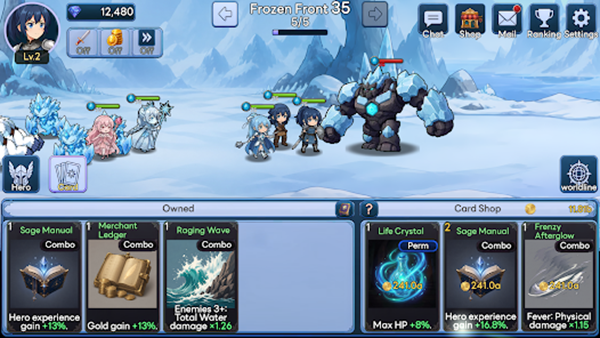
The card system underwent one of the clearest changes during the game’s 2026 development. Earlier pre-release information described 49 tactical cards arranged around a six-slot tactics board. The newer open-beta description instead lists 156 combo cards together with 12 permanent growth cards. For anyone relying on an older guide, this difference is significant: the current system offers a much broader set of possible interactions and places greater emphasis on linking several conditions rather than simply selecting a handful of generally useful bonuses.
Combo cards are designed around relationships between elements, hero roles and triggering conditions. As a result, the value of an individual card depends heavily on what surrounds it. A bonus that activates reliably with the current heroes can contribute more to a run than a seemingly stronger effect that is triggered only occasionally. This is where card building becomes genuinely tactical. Before changing several cards at once, it is useful to identify the main interaction responsible for damage or survival and then strengthen that interaction with supporting effects.
Growth cards serve a different purpose. The current game information describes 12 permanent growth cards that improve the squad without occupying a combo-card slot. That distinction allows persistent development and run-specific combinations to work alongside one another rather than compete for exactly the same space. In practical terms, growth cards support the long-term account while combo cards can be adjusted more directly around the present Worldline, current enemies and the behaviour of the selected heroes.
Creating Synergy Instead of Collecting Isolated Bonuses
A reliable combination usually begins with one clear objective. If the team’s strongest results come from frequent skill activations, supporting effects should improve the conditions that make those skills available and effective. If survivability is the main obstacle, adding unrelated offensive effects may do little to solve the actual problem. The same principle applies to elemental relationships: an element that receives favourable treatment from current conditions deserves more attention than it would in a neutral fight, provided suitable heroes and card triggers are available.
Players should also distinguish between effects that look impressive individually and combinations that work consistently over many stages. Idle combat repeatedly tests the same setup against rising opposition, so reliability has practical value. A chain that depends on several rare events occurring in the correct order may produce a spectacular battle occasionally but perform poorly over a long run. A simpler combination with frequently satisfied conditions can provide steadier progress, particularly when the objective is to pass another 30-stage milestone rather than achieve one unusually fast victory.
It is equally important to change cards for a reason rather than rebuilding a set after every difficult battle. Boss mechanics, elemental matchups and Worldline rules can each create different problems. Identifying which of those factors caused the failure makes the next adjustment more precise. If a boss survives because the squad lacks sustained damage, changing a defensive interaction may achieve little. If characters are defeated before their important effects activate, extra damage alone is unlikely to correct the weakness. The card system works best when adjustments respond to what is actually happening during combat.
Combining Heroes, Elements and Idle Progression
Aeterna Loop keeps automated combat at the centre of moment-to-moment play, but the idle structure does not remove team-building decisions. Hero synergies, elemental matchups, Fever bursts, bonus waves and bosses with distinct mechanics remain part of progression. The result is a division between preparation and execution: players build the conditions under which a squad should work, while combat tests whether those decisions remain effective as enemy strength increases. This makes checking a stalled run more useful than simply waiting for another increase in raw power.
Elemental relationships are particularly relevant when they overlap with card conditions and Worldline effects. The important point is not to force an elemental setup merely because one category appears theoretically favourable. A strong combination needs the heroes, triggers and supporting cards required to take advantage of that benefit. When those pieces are missing, a more coherent alternative may perform better. This keeps roster decisions connected to the wider build rather than reducing them to a fixed hierarchy of characters.
The continuously rising stage difficulty provides a practical way to evaluate these choices. A setup can appear powerful when enemies are comfortably below its limit, but its weaknesses become clearer as battles take longer. Damage may stop scaling sufficiently, defensive effects may fail to keep heroes alive through an entire encounter, or an important card condition may activate too infrequently. These signals help distinguish a temporary statistical barrier from a structural weakness in the current combination.
How to Approach Long-Term Progress in Aeterna Loop
For long-term progress, it helps to treat every loop as information rather than as a failed attempt whenever advancement eventually stops. A run shows which card interactions remain dependable, where a particular hero combination begins to struggle and whether the chosen Worldline route supported the intended strategy. That information can guide the next route more effectively than changing multiple systems at random. Since movement is limited to adjacent Worldlines, route planning also rewards remembering which branches produced useful conditions in earlier runs.
The 30-stage milestones give players natural checkpoints for reviewing a build. After reaching one, there is no requirement to abandon the run immediately, so the next stages can be used to test how much further the current setup can reasonably travel. If progress remains smooth, continuing has an obvious advantage. If battles become disproportionately slow or inconsistent, settling the loop and rebuilding around another connected Worldline may be more productive than attempting to preserve the same combination indefinitely.
Aeterna Loop therefore sits between a conventional idle RPG and a run-based tactical game. Automatic fighting reduces the need for constant input, while Worldline routes and card interactions determine how effectively that automation works. In its current 2026 form, the nine-Worldline structure, 156 combo cards, 12 permanent growth cards and uncapped stage progression make adaptation the main recurring task. The strongest approach is not to search for one permanent build, but to understand why a combination works, recognise when the surrounding rules have changed, and rebuild only the parts that no longer support the next stage of the loop.