
Twilight Towers: Merge Defense — How Merge Mechanics Meet Tower Defence on Mobile
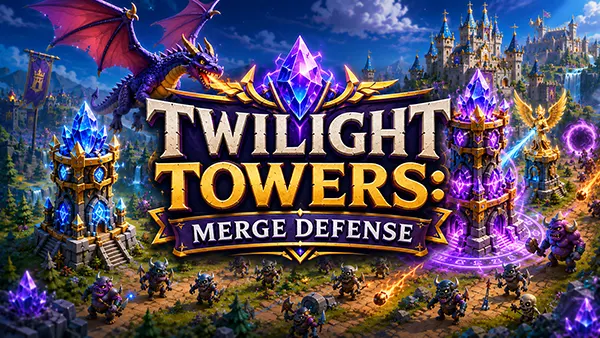
Twilight Towers: Merge Defense takes two familiar mobile-game ideas and makes them depend on each other rather than simply placing them side by side. Players manage a growing fantasy settlement in Fernhollow, combine matching objects to create stronger versions, prepare defensive towers and dragons, and then deal with waves of creatures emerging from the Blight. The result is a strategy game in which progress on the merge board directly affects performance in tower defence battles. Fortis Games has also changed the structure considerably during 2026, adding new tower systems, dragons, runes, exploration tasks and revised events. By August 2026, the game has become much broader than a simple merge puzzle with occasional battles: developing the kingdom, controlling resources and deciding which combat tools deserve investment are all part of the same long-term progression.
How Merge Mechanics Drive the Tower Defence System
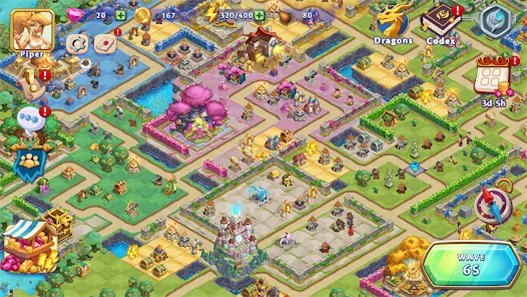
The basic rhythm of Twilight Towers starts in Fernhollow, where the player gradually develops a board containing towers, buildings, resources, harvesters and other useful objects. Matching items can be merged into higher-level versions, which means an apparently simple decision about clearing board space also has strategic consequences. A stronger tower is more useful when the next wave arrives, while a better building or resource-generating object can improve future production. This makes merging more than a separate puzzle between battles. It is effectively the development system behind the player’s defensive army, and poor use of space or resources can slow progress even when the actual combat stages are handled well.
Harvesters provide many of the items needed to keep that process moving. Energy is spent on production, objects appear on the board, and matching pieces can then be combined. Fortis has repeatedly adjusted this system during development, so older descriptions of Twilight Towers do not always reflect the current game. Following the major progression changes introduced in 2026, Energy capacity is linked to Castle development, while later updates continued to change harvesting and Villager behaviour. The August Steel and Stone update introduced worker-based automatic harvesting as a staged feature test and also added long-press gathering. These changes reduce some repetitive tapping, but they do not remove the need to decide how board space and resources should be used.
The defence portion gives those preparation decisions a practical purpose. Enemies travel from their entry point towards the Castle, while towers and dragons attack according to their own characteristics. A board full of low-level pieces may provide plenty of objects but leave the defensive line underpowered. Aggressively combining everything, on the other hand, can reduce the number of available units or consume items that would have been useful for another objective. Twilight Towers therefore creates a steady tension between immediate strength and longer-term development. The strongest move is not necessarily the merge that creates the highest-level object at that moment; it is the one that leaves the base better prepared for the next wave, territory requirement or event objective.
Why Efficient Merging Matters Beyond Clearing Space
One of the most useful habits is to avoid treating every available three-item match as an automatic instruction to merge. Fortis itself advises players to aim for five-item merges where possible rather than settling for three. The reason is simple: a five-item combination provides a more efficient return, helping players climb a merge chain while using fewer source pieces. The game also includes an Undo option for the most recent merge, which is useful when an object has been combined accidentally or when a player realises that waiting for additional matching pieces would produce better value. These small decisions become increasingly important as the board fills and higher-level items require more steps to produce.
The Bubble Merge spell, introduced in the Fury of the Styrm update in July 2026, pushes the same idea further. Instead of forcing players to track identical pieces scattered across the entire map and inside bubbles, it can combine eligible matching items across the board. Groups of five are processed at a five-to-two ratio, with a three-to-one fallback for remaining pieces. This is primarily a convenience feature, but it also shows how central merge efficiency has become to the game’s design. Large developed kingdoms contain far more objects than an early Fernhollow board, so tools that reduce repetitive sorting allow players to spend more attention on expansion, upgrades and preparation for combat.
Automators provide another way to control the growing amount of board management. They can help collect, merge and store items, making them useful once ordinary manual sorting starts consuming too much space or attention. Efficient players therefore have several layers of management to consider: which production source to use, when to spend Energy, which objects to keep separate, when to combine five pieces and when automation can take over repetitive work. None of these decisions requires complicated calculations, but together they distinguish Twilight Towers from a conventional tower defence game in which upgrades are purchased from a fixed menu. Here, much of the military progression is physically created and organised on the kingdom map before a wave even begins.
Towers and Dragons Turn Merged Progress into Combat Power
Towers form the backbone of each defence, but simply obtaining a higher-level tower does not solve every battle. Different threats place different demands on the defensive layout, and positioning matters because enemies follow visible routes towards the Castle. The August 2026 update improved path visibility and added clearer feedback showing where enemies will appear, making it easier to read the battlefield before committing to a wave. This matters on a phone screen, where tactical information needs to be understandable without lengthy menus. A player can see the route, consider the towers already available and make adjustments before the defence is tested by the next group of Blightspawn.
Dragons add a second layer because they are active combat units with individual attacks, elements and special abilities. Twilight Towers does not treat them merely as collectible companions. Their abilities can control groups, apply damage over time, hit several targets or stop enemies at critical moments. Tremortail, for example, is a Ground Dragon with high damage and a slow attack speed whose Quake ability can stun ground enemies across an eight-by-eight area. Styrm uses lightning attacks that can arc between several targets and has an ability that increases critical-hit chance and attack speed. The newer Titanius attacks with heavy stone shots and can launch a Stone Cannon that affects enemies across a wide area. Choosing a dragon therefore changes how a defensive position handles a wave.
This combination gives combat a useful division of labour. Towers provide the persistent defensive structure, while dragon abilities can answer situations that static damage alone may not handle efficiently. A fast wave may make slowing or stunning more valuable than another straightforward damage increase, while groups of closely packed enemies favour attacks that affect several targets. The game also includes elemental relationships, and the 4.0 update added an Element Wheel reference to the Dragon Details screen to make those match-ups easier to check. The objective is not to memorise a complex rulebook but to recognise that a successful defence comes from combining complementary tools rather than simply fielding whichever tower or dragon has the largest visible number.
Runes and Boost Towers Add More Ways to Shape a Defence
Runes provide another route for specialising towers. They become available once the Castle reaches Level 5 and can improve characteristics such as damage, range, attack speed and critical hits. Fortis introduced 15 Rune types, each available at different star ratings, so two otherwise similar towers can be developed towards different purposes. A tower covering a long approach may benefit from extra range, while one positioned where enemies remain within reach for longer might gain more from attack speed or damage. The system adds meaningful customisation without changing the basic mobile-friendly flow: players still create and improve their defences through ordinary progression, but there are more choices about what an upgraded tower should actually do well.
Boost Towers take a different approach because their value comes from helping nearby units rather than directly replacing them. The Clocktower, introduced in the Towers & Tremors update, applies a speed improvement to adjacent towers or dragons in a cross-shaped arrangement. That makes placement particularly important. A support structure positioned beside several effective attackers can contribute more to the battle than the same structure placed at the edge of the useful formation. Boost Towers have their own merge progression and sources, but Runes cannot be equipped on them. They therefore form a separate support branch rather than another conventional damage tower, encouraging players to think about the relationships between neighbouring defences.
The August 2026 balance changes reinforced this emphasis on combinations. Fortis adjusted Grid Elements, Element Combos, merge progression and related scaling while also fixing the Clock Tower so that its buff correctly affected nearby towers during waves. The same update introduced a tactical tutorial covering grid elements and enemy interactions, indicating that these relationships are now considered a core part of normal play rather than an advanced feature for a small group of players. Twilight Towers remains approachable because attacks run automatically once a wave is underway, yet the preparation behind them has enough depth to reward careful placement, sensible upgrades and the choice of a dragon whose ability solves the problem presented by a particular enemy group.
Fernhollow Progression Connects Battles, Expansion and Events
Winning waves does more than increase a battle counter. Fernhollow itself expands as the player meets progression requirements and clears access to new territory. The modern version of the game combines combat goals with development tasks, so advancement may depend on reaching a particular wave, defeating an important enemy, developing buildings or producing specified objects. Exploration Quests, added in July 2026, reinforce this connection. Up to four can be active, with objectives covering areas such as tower construction, dragon acquisition and wave progression. Completing them awards Exploration Torches, which are used when opening additional areas of the map. Expansion consequently reflects both military progress and the work carried out on the merge board.
Campaign mode provides a more controlled form of tower defence away from the main Fernhollow base. These stages restrict the tools available and ask players to protect Sunbursts from Blightspawn, which can require a different approach from simply relying on the strongest collection developed at home. Campaign progress also supplies rewards that feed back into the wider account. This is useful for the overall pacing because the main kingdom is persistent and steadily becomes more complicated, whereas Campaign stages can present shorter tactical problems with clearer boundaries. They give the tower defence half of the game room to stand on its own instead of making every battle depend entirely on the current layout of the main merge board.
Events provide a third form of play and have been revised several times during 2026. Twilight Towers has used Merge Events, Rush Events, Boss encounters, wave-based battles and Expeditions, with availability depending on progression and the current event schedule. Some activities reward direct combat performance, while others give value to efficient merging or resource use. Main Base Events received a major 4.0 overhaul in August, together with new tutorials for wave and boss events, milestone-point tracking and a dedicated Events area in the interface. This variety is important because it gives developed towers and dragons purposes beyond repeating ordinary waves and creates reasons to adjust priorities as temporary activities change.
What the 2026 Updates Mean for Mobile Players
Twilight Towers has changed unusually quickly during 2026, which makes the date of any guide important. Earlier versions used systems that have since been replaced, removed or reintroduced in another form. Mana and Blight merging, for example, was removed from the main Fernhollow base during a major redesign, although related mechanics can still appear in other activities. Villagers also went through substantial changes before returning to Fernhollow, where Houses and population once again influence how many can be present. By June, players could collect rewards such as Gold, Energy, Dragon Food or Gems from Villagers, while the August update began testing automatic harvesting tied to workers. Anyone returning after several months may therefore find a noticeably different progression loop.
The latest Steel and Stone Update 4.0, released on 17 August 2026, also concentrated heavily on usability and performance. It introduced a detailed Dragon information screen, clearer tower-generator information, an Energy refill timer, better enemy-path indicators, campaign energy items and revised tutorials. Fortis also reported work on frame-rate stability during Android wave transitions, combat visual-effect optimisation and general performance improvements, alongside a substantial collection of bug fixes. These details matter on mobile because a strategy game can become frustrating if a busy defence is difficult to read or large numbers of visual effects interfere with performance. The changes suggest that the current development focus is not simply adding more collectible content but making larger, later-game battles easier to manage.
Twilight Towers is free to download in supported regions and includes optional in-app purchases, including items involving random rewards, so availability and store information should be checked for the player’s region. Regional release status has not always been identical between Android and iOS storefronts. The game also demands more attention than the visual style might initially suggest: efficient five-item merging, board organisation, tower positioning, dragon abilities, runes, Boost Towers and event objectives gradually build on one another. Its strongest idea is the connection between these systems. Merging is not merely an activity used to fill time between fights, and tower defence is not an occasional mini-game attached to a merge board. Each side supplies resources, objectives and progression to the other, giving Twilight Towers a distinctive structure among mobile strategy games in 2026.