
Vampire Therapist: Psychological Puzzles and Cognitive Behavioural Therapy in a Mobile Game
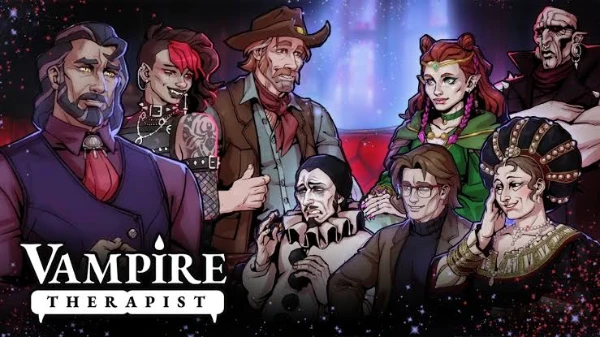
Vampire Therapist takes an unconventional approach to mobile gaming by turning psychological conversations into interactive puzzles. Developed by the independent German studio Little Bat Games, the visual novel originally appeared on computers on 18 July 2024 before reaching consoles in February 2026 and iOS and Android devices on 24 November 2026. Instead of hunting supernatural creatures or fighting enemies, players assume the role of a former gunslinger who helps other vampires understand their emotional difficulties. The gameplay incorporates principles of cognitive behavioural therapy (CBT), combining psychological concepts with historical fiction, dark comedy and character-driven storytelling. The mobile edition makes this unusual combination accessible to players who prefer narrative adventures on smartphones and tablets.
The Story and Gameplay of Vampire Therapist
The central character is Sam, an American vampire whose previous existence involved violence and the dangerous lifestyle of the Wild West. Having reconsidered his relationship with humanity, he chooses an entirely different occupation: helping other immortal beings understand their psychological problems. His journey takes him to Germany, where a therapy practice operates above a gothic nightclub. The contrast between the atmospheric surroundings and the intimate conversations inside the consultation room establishes the distinctive identity of the game. Vampires are presented not simply as supernatural predators but as individuals struggling with loneliness, regret, insecurity and the consequences of their decisions.
Sam receives guidance from Andromachos, a vampire approximately 3,000 years old who introduces him to therapeutic principles and supervises his development. Their relationship provides the foundation for the game’s educational elements. Andromachos explains unfamiliar psychological concepts before Sam encounters situations in which they become relevant. His guidance helps players understand why a particular statement reflects an unhealthy thinking pattern and how it might be approached differently. This gradual introduction makes the experience accessible to people without previous knowledge of psychology, while the conversations retain enough complexity to remain interesting beyond the introductory sessions.
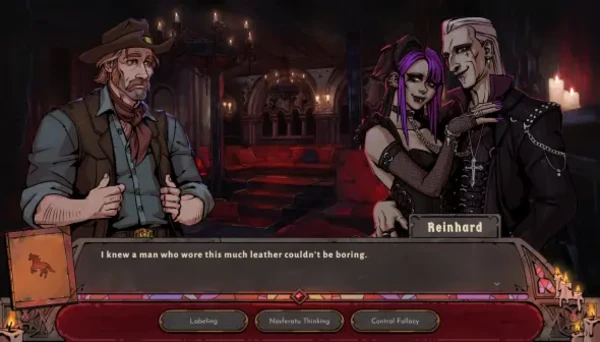
Unlike conventional adventure games, Vampire Therapist builds progression around conversations rather than physical challenges. Players listen to clients, examine their statements and select psychological concepts that correspond to particular patterns of thinking. New information gradually changes their understanding of each character, revealing contradictions between personal beliefs and actual experiences. The difficulty comes from interpreting language and recognising emotional context rather than reacting quickly or memorising complicated controls. There is no traditional defeat condition, and incorrect responses provide opportunities to reconsider an interpretation. This design encourages thoughtful participation without creating unnecessary pressure during emotionally sensitive scenes.
Vampire Clients and Their Psychological Conflicts
The characters come from different historical periods, allowing the writers to examine how social expectations and personal experiences influence behaviour. Dr Drayne, one of Sam’s clients, is a scientist whose conversations reveal complicated attitudes towards himself and others. His intellectual confidence does not necessarily translate into emotional understanding, creating an interesting distinction between professional competence and personal vulnerability. Sessions with him demonstrate how established beliefs can influence the interpretation of unfamiliar situations, particularly when an individual has spent considerable time developing rigid assumptions about the surrounding world.
Other clients introduce different perspectives. Isabella’s relationship with art, personal identity and historical experiences provides material for conversations about self-perception, whilst Edmund’s interactions raise questions about interpersonal manipulation. Meddy connects the supernatural setting with contemporary digital culture through her involvement in online streaming and social media. Her storyline illustrates how modern concerns about attention, public recognition and social interaction can affect someone whose existence began centuries before the internet. These characters prevent the narrative from becoming a repetitive series of conversations about identical emotional problems.
The historical backgrounds also serve a broader narrative purpose. Immortality allows the writers to exaggerate the persistence of unresolved conflicts without abandoning recognisable human experiences. A disagreement that might trouble an ordinary person for several years can become a defining feature of a vampire’s existence for centuries. The characters’ difficulties are frequently presented through humour, but the underlying subjects receive serious attention. By gradually revealing their histories, Vampire Therapist encourages players to reconsider initial impressions and recognise that apparently unreasonable behaviour can have complicated origins. Sam’s own experiences reinforce this idea, making his development as important as the progress of his clients.
How Cognitive Behavioural Therapy Becomes a Psychological Puzzle
Cognitive behavioural therapy is an established form of psychological treatment concerned with relationships between thoughts, emotions and behaviour. In Vampire Therapist, selected principles of CBT become the foundation of an interactive gameplay system. Players encounter statements that may contain cognitive distortions, meaning patterns of thinking that contribute to inaccurate or excessively negative interpretations of events. Rather than accepting every statement at face value, Sam must recognise when a client’s interpretation extends beyond the available evidence. The developers worked with qualified therapists to review the psychological concepts incorporated into the game, although the resulting experience remains a fictional interpretation of therapeutic practice.
One particularly recognisable concept is all-or-nothing thinking, in which circumstances are interpreted through extreme categories without acknowledging intermediate possibilities. For example, someone might consider an entire evening unsuccessful because one conversation became uncomfortable. Another concept is catastrophising, which involves anticipating excessively negative consequences from a situation. A character experiencing this pattern might treat an ordinary disagreement as evidence that a relationship is about to collapse. These illustrative examples demonstrate the kind of reasoning players need when identifying distorted interpretations during conversations with vampire clients.
The game gradually introduces additional concepts, expanding the number of possible interpretations available during sessions. Emotional reasoning, overgeneralisation and the dismissal of positive experiences represent further patterns relevant to understanding the characters’ difficulties. The challenge becomes more substantial when several interpretations appear plausible within the same conversation. Players must consider the precise meaning of a statement rather than simply identify negative language. This distinction gives Vampire Therapist its identity as a psychological puzzle game: the solution depends on understanding how a character reaches a particular judgement, not merely recognising that the character feels unhappy.
Recognising Thinking Patterns Through Interactive Conversations
The consultation system makes psychological terminology easier to understand by connecting abstract definitions with fictional circumstances. Reading about overgeneralisation in a psychology textbook may explain its meaning, but recognising it within an emotionally complicated conversation requires a different kind of attention. Vampire Therapist repeatedly places players in situations where they must distinguish an isolated experience from a broader conclusion that a character has drawn. Over time, the relationship between the psychological concept and its practical expression becomes clearer, giving the educational material a more memorable context than a simple collection of definitions.
Another important feature is the absence of punishment for incorrect interpretations. Players can reconsider their answers without losing progress through a conventional game-over sequence. This approach is appropriate for a subject that requires patience and careful communication. It also acknowledges that understanding another individual’s perspective is rarely an immediate process. Short activities involving mindfulness and breathing introduce a different rhythm between more demanding conversations. These moments complement the narrative by showing that emotional awareness involves more than analysing statements and identifying errors in reasoning.
Nevertheless, identifying a cognitive distortion in a scripted conversation is considerably different from conducting actual psychological treatment. Real CBT may involve collaborative goal-setting, individual assessment, behavioural exercises and continued work outside therapy sessions. Human experiences cannot always be classified through a predefined selection of answers. Vampire Therapist simplifies these complexities to create understandable gameplay, and its educational contribution should be considered within that context. The game can introduce useful psychological vocabulary and encourage reflection, but it is neither a diagnostic instrument nor a substitute for professional mental health support.
Vampire Therapist on Mobile Devices in 2026
The release of Vampire Therapist for iOS and Android on 24 November 2026 marks an important development for a game originally designed for computer users. Little Bat Games adapted the interface for touchscreen interaction, making dialogue selection and psychological classification more suitable for handheld devices. The existing gameplay translates naturally to this format because it does not depend on rapid movement, precise aiming or complicated combinations of buttons. Players primarily interact with conversations and selectable responses, allowing the narrative to retain its central characteristics without requiring the control arrangements associated with its earlier computer and console editions.
The mobile release follows a free-to-start distribution model. Players can download the application and experience the tutorial alongside the first two complete therapy sessions before deciding whether to purchase further content. The iOS edition offers individual chapter purchases and bundled access to subsequent parts of the story. Couples Therapy, the additional narrative episode, is also available as paid content. This arrangement provides an opportunity to assess the writing, character interactions and psychological mechanics before spending money. Exact purchase prices should be checked through the relevant regional app store, as pricing may differ between countries.
According to the App Store listing available in November 2026, the iOS edition requires iOS 15.0 or later, occupies approximately 1.9 GB and supports both iPhone and iPad. The listing identifies English as the supported language, assigns a 16+ age rating and estimates the main narrative at approximately eight to eleven hours. Its substantial voice acting contributes to the presentation, with performances from Matthew Mercer, Sarah Grayson, Francesca Meaux and the game’s creator, Cyrus Nemati, among others. For mobile players, the combination of spoken dialogue and written conversations provides a more theatrical experience than a conventional text-based puzzle adventure.
Additional Content and the Educational Value of the Game
The Couples Therapy expansion extends the original premise by shifting attention from individual psychological difficulties towards relationships between vampires. Immortality introduces unusual complications into familiar interpersonal conflicts: disagreements can remain unresolved for generations, resentment can accumulate over centuries, and established relationship dynamics may become increasingly difficult to reconsider. Players must pay attention to competing perspectives rather than concentrating exclusively on one client’s interpretation. The expansion addresses subjects such as emotional dependency, resentment and communication difficulties, adding variety to the psychological challenges presented in the main storyline.
The game’s distinctive approach has received recognition beyond conventional entertainment coverage. Vampire Therapist earned a Games for Change award, recognition at the German Computer Games Awards and a BAFTA Games Awards nomination. Such recognition reflects the unusual combination of researched psychological material, historical storytelling and accessible interactive design. However, awards for narrative quality or educational innovation do not establish clinical effectiveness. The game’s most defensible educational contribution is its ability to introduce selected psychological concepts through memorable fictional situations, providing an accessible starting point for readers and players interested in how thinking patterns influence everyday experiences.
Vampire Therapist occupies an unusual position within the mobile gaming catalogue in 2026. It offers neither the immediate competition of action games nor the familiar numerical challenges of traditional puzzles. Its principal attraction is the opportunity to understand complicated characters through conversation, observation and interpretation. Players interested in psychology, gothic fiction and narrative adventures may appreciate its slower pace, historical references and willingness to address uncomfortable emotional subjects through humour. Its value ultimately lies in making psychological ideas approachable without presenting personal difficulties as problems with universally applicable solutions. For anyone seeking a story-driven mobile game that rewards attention and reflection rather than speed, Vampire Therapist represents a distinctive alternative to more conventional releases.